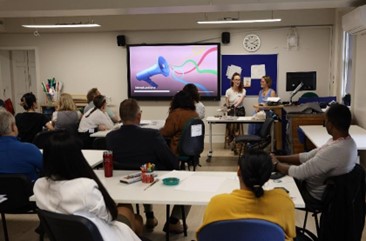
Last month Alicia and I hosted a reflective art workshop at Roehampton University. Alicia Gradon is a British artist and practicing art psychotherapist, she has a broad range of experience in community mental health services and specialises in connecting art with nature’s story. Discover Alicia’s work on Instagram @aliciagradonart. It was a privilege to be part of the first conference at Roehampton focusing on service user and carer co-production in higher education. One of the key take-aways which resonated with us on the day was provided by a person in our workshop. They questioned the use of the term ‘service user’, this provided us with some rich feedback, as art therapists and past service users, about our own perception and relationship with this term. For this reflective article, we will swap the term service user for individuals.
Over the past few years Alicia and I had shared many conversations about the lack of individual voice, in health and wellbeing services, in our training. This lack of voice drove Alicia to write a research project specifically addressing the lack of authentic voice in art psychotherapy literature.
Individuals, carers, lecturers, students, and healthcare workers came together for the day to address this central question, ‘how do we all work together more effectively to value the knowledge and voice of every individual involved in providing high quality care’.
Whilst working in the NHS in a young offender’s institute I was saddened and surprised by the lack of voice the children had within the oppressive secure environment they resided. The competing objectives of a system set up to punish and care for the children residing there intensified the challenge for those wishing to provide emotional support. Children with complicated personal histories who have experienced multiple layers of disadvantage often present a range of complex needs. They are likely to have experienced social and school exclusion, deep poverty, often have been designated a Child in Need and have been exposed to high levels of maltreatment and intergenerational violence.
Alicia found similar reflections while working in an acute mental health ward, the people receiving treatment within this setting often did not have their voice centred within their care. Acute mental health services endeavour to provide a therapeutic environment to stabilise and support individuals. However, the process of admission into a secure environment can result in distancing the most marginalised individuals even further from mainstream society. Individuals are sealed away with their own and other people’s psychological crises. The process of admission into an acute mental health ward has extreme implications for personhood, with potential long-term impact on social identity and position, feelings of powerlessness and institutionalisation.
Acute mental health settings can be chaotic and unpredictable, placing critical levels of pressure on staff who work within short-term treatment schedules and ever-changing procedures whilst maintaining consistent, secure levels of safety to support the severely unwell people in their care. For people receiving care on the wards, there is a demand for conformity with an established routine, and an inevitable expectation of progression in recovery being equated with achieving ‘normal behaviour’.
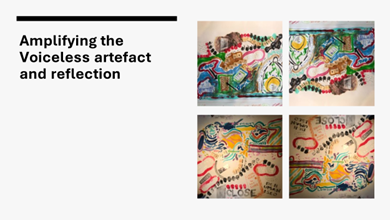
Alicia and I were brought together by a common theme which was how can we think about individual voices when they simply don’t have one. We shared a co-produced video artefact of some of the challenges we had felt working in these high-risk settings and invited the audience to reflect whilst engaging with the art-making process. We were both a bit nervous about how this would work out, but we were pleasantly surprised as we observed lots of people engaging in artmaking and discussions with each other in small groups.
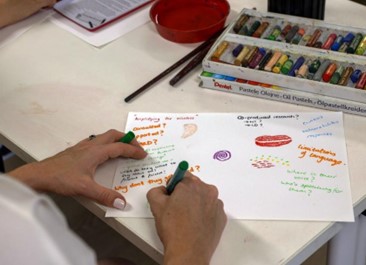
Responding together in creative ways offers fresh insight into our unconscious processes in play. Thinking about the individual voices in high-risk settings has been difficult, and we remain curious about our own defensiveness. We felt reluctant whilst making our video which possibly echoed the resistance of people being asked to engage with mental health professionals. By allowing ourselves to be vulnerable, we have attempted to make artmaking and the voice over of our video unscripted and authentic. This was a conscious attempt to deflate the power we hold as therapists, and which is structurally held in educational settings like Roehampton University. We look forward to building on our experience at this unique conference and the development of a co-production network in the future.